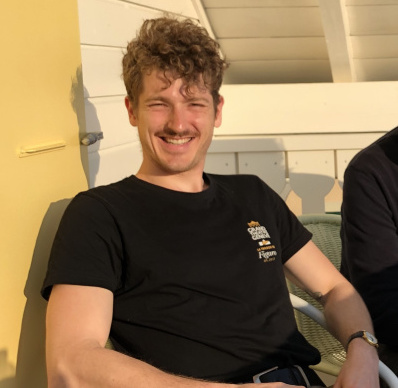
David Blunier
I am a lecturer in linguistics at the University of Poitiers. As a linguist, my main interests lie in semantics and pragmatics of natural languages, which basically means that I am interested in how languages express meanings, and how these meanings are affected, shaped, and enhanced by general reasoning patterns pertaining to human cognition. I like comparative research, and try to ground my theoretical work as much as possible using linguistic typologies, across languages and modalities.
A significant part of my research is dedicated to the study of sign languages and the impact of modality over linguistic meaning. In addition to my current project on grammatical Number in French Sign Language, I have been working on anaphora and ellipsis in Catalan Sign Language with co-author Giorgia Zorzi (Bergen), and on Sign Language of the Netherlands (NGT) with Evgeniia Khristoforova (Universiteit van Amsterdam), with whom I have investigated the various patterns of anaphora involved in role shift.
I recently obtained my PhD from the University of Geneva, where I defended my dissertation under the supervision of Isabelle Charnavel (Geneva) and Yasutada Sudo (University College London). My dissertation is about indexicals, those natural language expressions that refer to elements of the utterance context; more precisely, it focuses on their behavior in speech reports in both spoken and signed languages. I have been working on indexical shift, a phenomenon that describes first and second person pronouns being interpreted anaphorically in complex clauses, as well as logophoric pronouns. Topics I’m interested in include grammatical features such as person and number and their typologies, implicatures and the role of alternatives and competition in natural language, attitude reports, and the pragmatics of fiction.
My non-academical interests are, among many, calisthenics, opera, poetry and cinema.
You can contact me at david.lucas.simon[at]gmail.com
Current projects
The semantics of Number in French Sign Language (joint work with L. Couteau)
French Sign Language (LSF) has various means to express plurality: through classifier handshapes, introduction of loci in the signing space, and reduplication. This latter form is highly constrained morpho-phonologically, and is only licensed on a subset of signs with specific phonological specifications. Overall, the expression of plurality is highly context-dependent, and bare nouns can also refer to plural entities in the right context. Conversely, reduplicated nouns in downward-entailing contexts can be interpreted inclusively, i.e. judged true of single individuals, providing evidence that the `more than one’ reading of reduplicated plurals is obtained through a plurality inference. Our work explores how this inference comes about, especially with regard to the theory of alternatives: if bare nouns are also compatible with pluralities, what is the competitor of reduplicated forms?